BLOG

Scaling Complex Aerospace and Defense Manufacturing Programs
At Focused on Machining, we’re proud of our ability to produce complex, tight-tolerance components with our true 5-axis machining and other capabilities. But just as important, we are always prepared to expand our capabilities and capacity as a customer’s program grows.
Over the past several years, we’ve proved repeatedly that we’re ready to help aerospace and defense customers by investing in new equipment when their production requirements call for it.
Case Study: Investing in a Complex Component
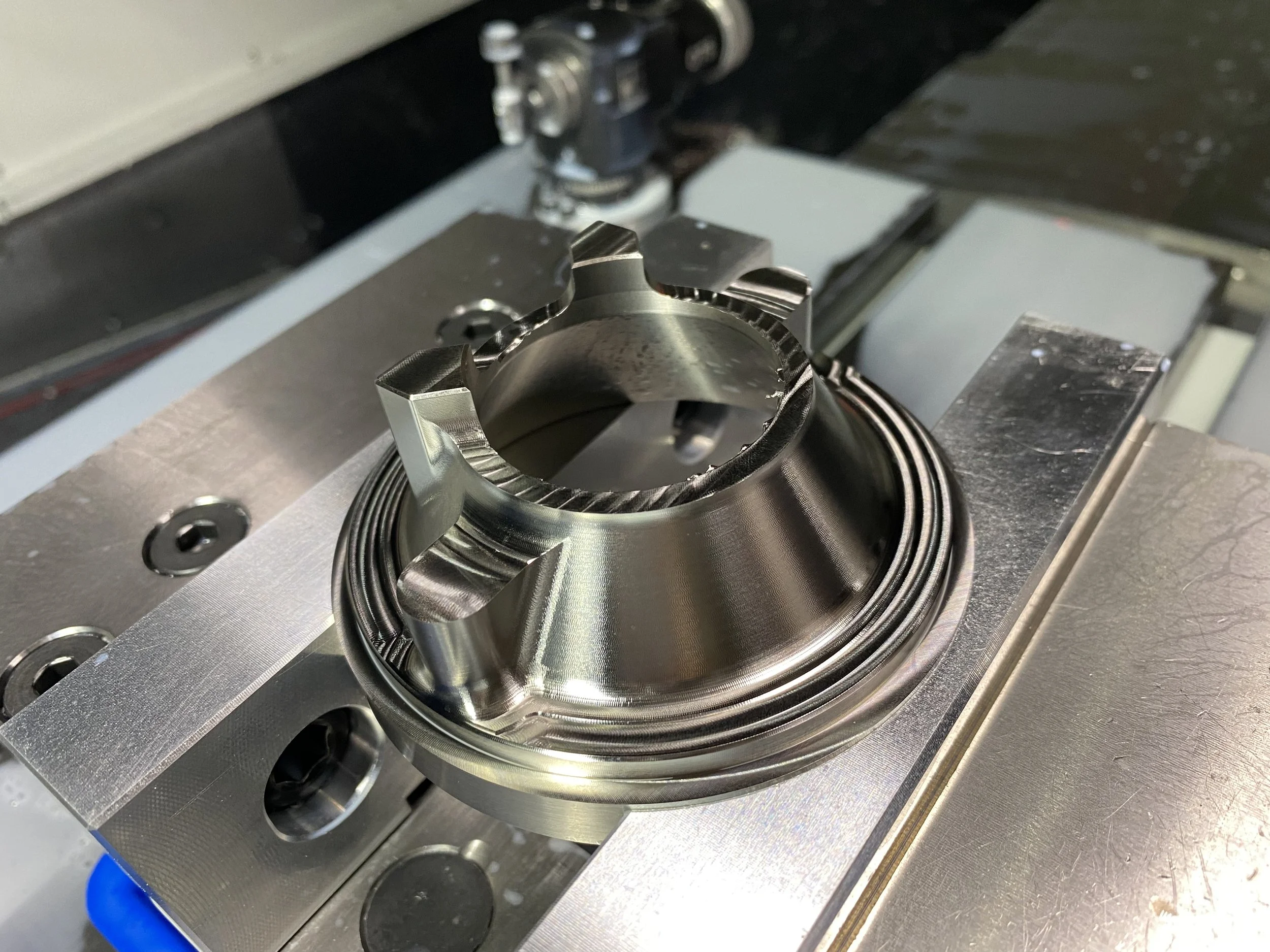
About a year ago, a customer approached us with an extremely complex metal 3D-printed part that needed full-5-axis machining. We proved out a machining process and manufactured it successfully, and they were happy with our results.
The program grew and the customer needed significantly higher volumes. But their next order came with a quick timeline, and our capacity was filled on the machines involved.
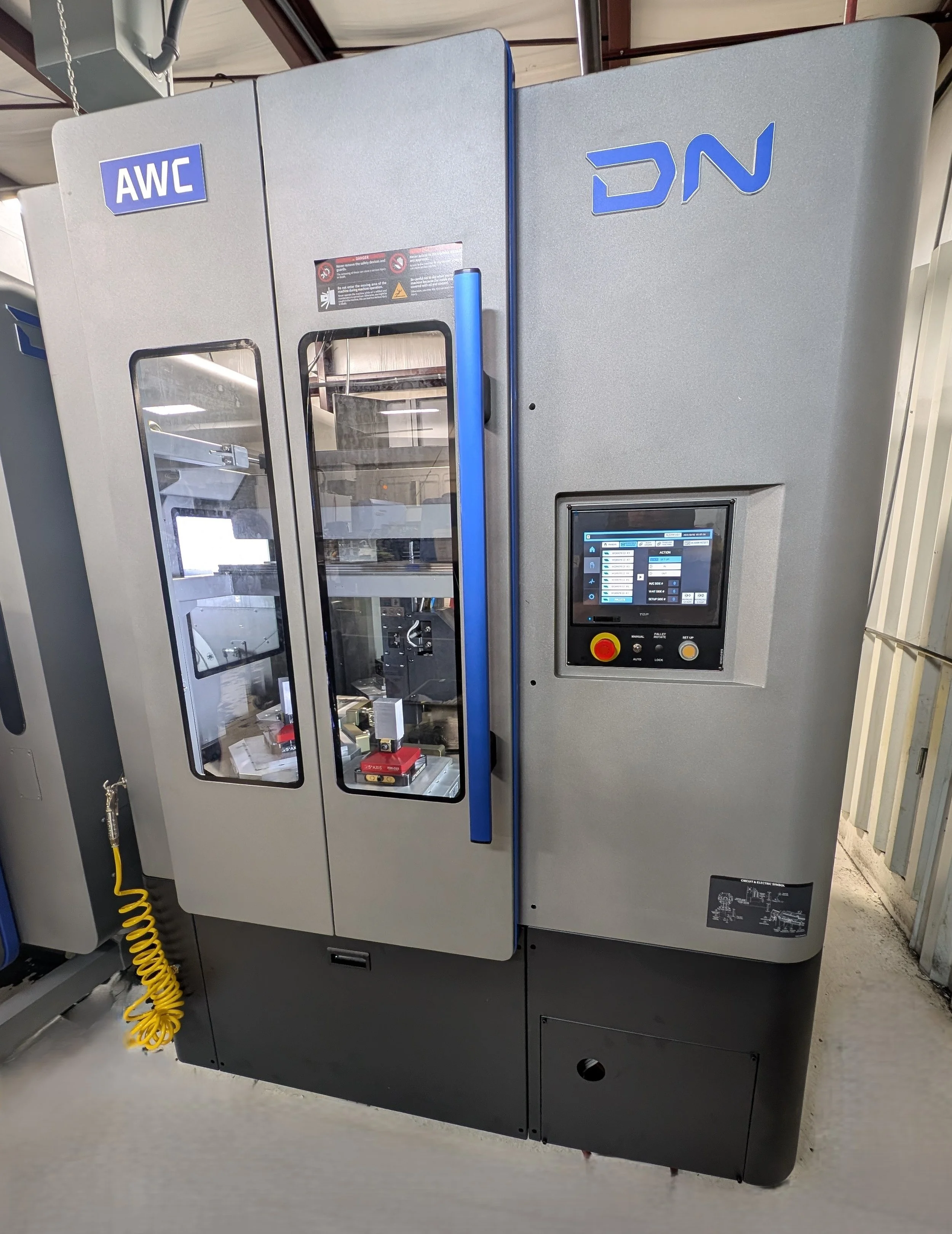
We didn’t just accept this bottleneck; instead, we wanted to take major steps to help them meet their goals. We ordered a new multi-axis lathe with live tooling, along with an additional coordinate measuring machine (CMM). This equipment will not only support this program, but it will also expand our capabilities for future aerospace and space projects.
The new lathe will initially be dedicated to this component, creating the production capacity needed for the growing program. And the CMM will significantly accelerate inspection, so we can maintain quality standards while moving parts through production more efficiently.
How We Support Our Customers
We were willing to make this commitment in defense and aerospace machining because we view our customers’ growth as an opportunity to evolve alongside them. When a customer trusts us with a long-term program, we look beyond the current order and consider what will be necessary to enable success over the long-term.
This is not a new approach for our precision machine shop. Several years ago, one customer’s designs started to grow in complexity. Parts that once required only one or two machining operations began requiring three to five.
Because of those changes, we saw an opportunity and invested in a 5-axis machine. That decision allowed us to serve the customer more effectively while building capabilities that opened the door to additional long-term programs, including work for defense prime contractors.
The Next Steps in Building Capabilities
Our latest equipment purchases follow the same philosophy: we’re helping our customers today while thinking of their needs tomorrow, as well. The new multi-axis lathe is being acquired with an immediate program in mind, but we chose a machine with capabilities that can handle more than the current part.
The lathe has both live tooling and multi-axis capability, which will let us complete complex turned and machined features in fewer setups. Once the current program’s needs slow down, that capacity will also be available for future projects.
You can have confidence that we’ll do what it takes to support your future production, whether that’s higher order volume or greater complexity. We can collaborate with you to understand what it will take to scale successfully.
Discuss Your Next Complex Machining Program
We want to become a strategic manufacturing partner that can solve difficult machining challenges and grow with your program over the long term.
Do you have a complex aerospace or defense part or a program that is ready to scale? Contact Focused on Machining to discuss how our team can support your next project!
The Value of GD&T Expertise in Machining Tight True Position Tolerances
True position is one of the most useful controls in GD&T, but it can also be a challenge for many machine shops. At Focused on Machining, we produce parts with demanding position requirements thanks to our deep understanding of GD&T and our experience with tight tolerance machining.
What a True Position Callout Actually Controls
A conventional size tolerance will usually apply to a single dimension, but a position tolerance controls the location of a feature relative to its theoretically exact position. That location is established by basic dimensions and, in some cases, a datum reference frame.
When a datum reference frame is used, even very small variations in the datum features, setups, and machined features can add up and cause a part to fall out of tolerance. This is why a position callout that appears comparable to an ordinary plus-or-minus tolerance may be far harder to achieve.
Part Example: Datum Relationships Add Complexity to a Waveguide
One recent example of our work with true position was a waveguide assembly we produced. The design had multiple pieces that fit together a bit like a clamshell, with an internal channel, passages, mating faces, and mounting interfaces that all had to align correctly.
The position of the channel was controlled relative to a three-datum reference frame. But with a positional tolerance of only 0.002 inches, there was almost no room for variation once the part was aligned to those datums. A small deviation in a referenced feature would have a significant effect.
The callout was critical to the part’s function, and we were ready to meet these requirements. But in creating designs, it’s helpful to understand why these tolerances can be challenging to machine and inspect.
Multi-Axis Machining Helps Preserve Feature Relationships
One of the best ways to handle true position is to machine as many features as possible in a single setup. At Focused on Machining, we use 5-axis machining and 4-axis horizontal machining to reach multiple sides of a component without having to remove it and reposition it.
Inspection is just as important. For parts with tight position callouts, we usually perform a comprehensive first-article-style inspection. If an adjustment is required, we’ll reinspect the entire part to confirm that the change didn’t create any new problems.
Our Recommendation: Specify Position Tolerances With Function In Mind
Tight position tolerances are appropriate when a part’s fit or performance requires them, but it’s important to be aware that challenging callouts do typically increase price by adding to programming, machining, and inspection.
It’s often helpful to review each callout in relation to the part’s functionality and consider whether a datum can be relaxed.
A Partner for Your GD&T Designs
Focused on Machining is ready to take on your designs with demanding true position requirements, and we can also help you identify opportunities to potentially simplify production. If you need a manufacturing partner experienced in GD&T, request a quote today.
How More Part Information Can Lead to Better Pricing
When engineers send a print to us, the drawing usually communicates important requirements through details like tolerances and finishes. Those are essential, but they do not always tell the full story of how the part will actually function in the real world.
At Focused on Machining, we often ask customers for additional information about their parts and projects because what we learn can change how we approach the work. With greater context, we can align our machining strategy with your project’s priorities.
Learn why we can deliver a better quote when we know more about how a part will be used.
The Application Can Clarify Tolerances
We can machine parts with very tight tolerances, and we know that some applications make tight tolerances absolutely necessary. As an AS9100 Rev. D machine shop, for instance, many of our components will face punishing conditions in space that require expert tight tolerance machining.
But sometimes, a tolerance may be tighter than the application truly requires, and that may drive costs higher than necessary. When we understand the function of the part, we can ask better questions. If a tolerance can be relaxed without affecting the final assembly, that may create an opportunity to reduce machining time and cost.
Structural Parts Require a Different Approach
Another helpful piece of context is understanding whether a part is structural or non-structural.
If a component is part of the solid structure of an aircraft or rocket, we need to be especially careful about how we machine it. We do not want to put unnecessary heat or stress into the material or weaken the part through our machining.
Mounting Details Can Change the Fixturing
A standard machining setup might involve holding material in a vise. But if the part will not experience that kind of force when it’s being used, squeezing it in a vise could create stress that causes movement once the part is released.
In those situations, we may choose a different workholding strategy. We might make a custom fixture, for example, or use another method that better mirrors the way the part will be used. We aim to machine and inspect the part in a way that is as close to the real assembly as possible.
A Case Study in the Importance of Context
One of our recent projects involved a waveguide, which helps guide radio signals through an antenna system and into a computer for processing. These parts can be extremely precise because the internal geometry affects how signals move and how certain frequencies are filtered.
In this case, the part had an internal channel that turned 90 degrees, with tight tolerances on the width, height, and end-to-end dimensions of the channel. Because so much material had to be removed internally, the part began to twist slightly during machining.
After talking with the customer, we learned how the waveguide would be bolted into the final assembly and how other waveguide sections would attach to it. With this information, we made our own fixture to simulate that mounting condition, using the same hardware the customer specified. Once the part was mounted that way, the twisting was controlled, and we were able to machine and inspect it more efficiently.
Better Information Leads to Better Pricing
Sharing more application details can create a more reliable process for both engineers and buyers. If we know important details about your part upfront, we can help you meet your most important priorities, whether that’s tight tolerances or improved pricing.
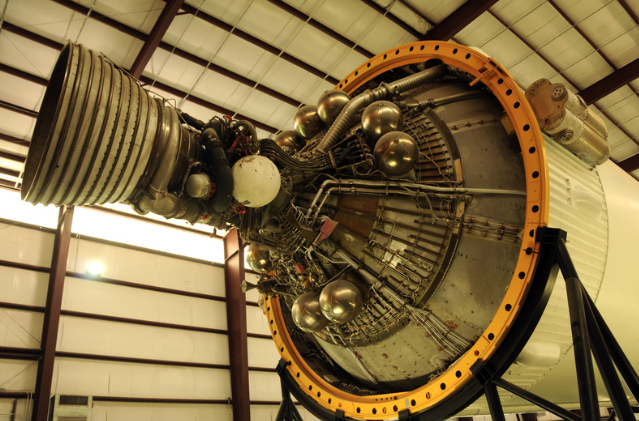
Precision Machining for Aerospace Engine and Motor Parts
Many aerospace, defense, space, and drone propulsion applications depend on hard, exotic metals that can handle extreme environments. Those materials can be challenging for many suppliers, but at Focused on Machining, our experience gives us the confidence to machine complex, tight-tolerance components from them.
Why Propulsion Components Require the Right Partner
When the application is an engine, a rocket motor, a thruster, or another propulsion component, the requirements are rarely simple. These parts need to withstand very demanding environments and operating conditions, including significant temperature swings and intense forces. In many cases, they’re also tied to programs that have little room for delays.
That combination makes experience extremely important. A shop that has little experience with these materials may underestimate the lead times or machining challenges involved. In this type of work, a missed estimate can create delays of weeks or months as problems build on each other.
Our Experience With Difficult Metals
Many engine and rocket motor components are made from materials such as:
These materials are often selected because they can perform in difficult environments. But those qualities can also make them significantly more challenging in aerospace machining than aluminum or standard stainless steel.
While many machine shops avoid them for that reason, at our AS9100 Rev. D machine shop, we have spent years learning how to manufacture precision components from them consistently. That experience changes the way we approach an RFQ. An Inconel quote does not create uncertainty for us. We understand the tooling, coatings, feeds, speeds, and process planning needed to produce the part while protecting the customer’s schedule.
Accurate Planning for Tooling, Cost, and Lead Time
One of the biggest challenges with exotic materials is that the true cost of the job is not limited to the raw material. Tooling can become a major factor. A tool that lasts for thousands of parts in a more forgiving material may have a much shorter life in Inconel or A286.
Because we understand that up front, we can build realistic tooling expectations into the quote instead of discovering the issue during production. That creates more accurate pricing for the customer and helps prevent surprises after the job begins.
The same experience helps improve lead-time accuracy. For these projects, it is important to have the right tools and equipment ready before production starts. We routinely machine tight tolerances in these materials and can create complex components with 5-axis machining, but the success of the job depends on planning the full process correctly from the beginning.
The Supplier Network for Better Results
Customers also benefit from our extensive and trusted supplier network.
For instance, exotic materials can be harder to source than common metals, and availability can vary significantly from vendor to vendor. But for our projects, we reach out to multiple trusted suppliers to compare pricing and lead times. In some cases, the first vendor may need to source it from a mill, but we’ll be able to find another supplier that has the material on the shelf because of our connections.
That visibility helps us make the right decisions for customers when we’re managing their material sourcing or post-processing. If speed matters, we can identify the path that supports the schedule. If cost is the priority, we can help evaluate the best available option.
Choosing the Right Machine Shop for Engine Parts
The truth is that, for OEMs and defense suppliers, the most important factor in choosing a supplier should be experience. A shop with real experience in exotic metals will quote more accurately and deliver more reliably.
3 Recommendations for Revision Control Best Practice
In manufacturing, revision control is a topic that rarely creates issues because both manufacturers and engineers take it so seriously. But when best practices break down even in small ways, they can create risk for everyone involved.
At Focused on Machining, we have strong systems in place to catch revision issues before they reach the shop floor. Even so, we have a few recommendations for revision control best practices to keep the manufacturing process clear from the beginning.
1. Don’t Restart at Rev A for an Existing Part Number
This is a rare issue, but it’s one we’ve seen happen after acquisitions or rebrands. A new team may inherit an existing part number and want to treat the current design as its new baseline. To them, restarting at Rev A is logical.
We understand the idea, but from a manufacturer’s point of view, that creates serious risk. If we have already made that same part number through Rev A, Rev B, Rev C, and beyond, our ERP system already has those revisions in its history. The current revision may be Rev J or Rev N, while the previous versions are archived. If a customer sends the same part number back to Rev A, there are now two different Rev A versions connected to the same part number.
We have extensive safeguards in place to prevent rev control issues, but this still creates an avoidable risk of confusion. If an order is entered against the incorrect Rev A, the incorrect part could be manufactured and delivered before anyone realizes the issue. At that point, both sides have lost time and money.
2. Be Clear With Your Manufacturing Partner About What Changed in a New Revision
When you send us a new revision, it’s helpful to identify specifically what has changed from the previous version. We are able to compare prints and work through the differences, but that process takes time. We may have to review the print callout by callout to be sure we didn’t miss anything.
A simple summary can make a major difference. When you give us context, we can quote the revision faster and plan the work more efficiently. Without it, we may need to treat the job almost like a brand-new part because we can’t afford to assume anything remains unchanged.
3. Treat Every Change as a New Revision
Even small changes should be controlled through a new revision. Customers may inform us that they slightly altered the hole size but didn’t change the rev. That change may seem minor, but it can affect tooling, setup, inspection, and the way the job is processed. If the print still says Rev A, but the part is no longer the same Rev A we made before, the risk of a mix-up increases.
This most commonly occurs with notes on the print. Even when the geometry does not change, updates to the notes should still be handled as a new revision. A different finish, material requirement, inspection requirement, or outside process can affect what needs to happen after precision machining. The part will not be the same from a manufacturing standpoint.
If anything at all changes on the print, the safest thing to do is issue a new revision.
Good Revision Control Protects Your Timeline
Strong revision control allows us to quote faster and deliver the correct parts on schedule. Our ERP system and review processes help us catch many potential issues, but following best practices can also help prevent any confusion.
If you’re updating an existing part and creating a new revision, talk to our Colorado machine shop about how we can help!

Why Defense Primes Should Still Look For CMMC Level 2 Suppliers
By Justin Quinn, President and Owner of Focused on Machining
A buyer from a large defense prime recently reached out to us at Focused on Machining. He was looking for a new defense supplier that could take on programs that require CMMC Level 2 compliance.
We were happy to talk to him about his program and provide a quote. We are currently 95% complete with our CMMC Level 2 preparation, with a clear Plan of Action and Milestones (POA&M) in place.
But that conversation made us realize something: a major challenge is on the way across the defense manufacturing supply chain. The defense industrial base is under pressure to move faster than ever; at the same time, CMMC requirements may soon be phased into DoD contracts, even as the next phase of implementation is under review.
This combination could create real timeline issues for primes and suppliers that wait too long to act.
The Potential CMMC Supply Chain Crunch
The buyer told us that much of his recent time has been spent searching for CMMC Level 2 suppliers. Historically, his company had a large supplier base and could choose from a wide range of capable shops.
But with CMMC requirements continuing to evolve, that flexibility is beginning to shrink. And this change is happening against a broader push across the defense industrial base to strengthen supply chains and deliver critical capabilities at greater speed and scale.
Many of the suppliers this buyer currently works with are talented small shops that have supported defense work for years. But some haven’t looked deeply into CMMC, while many others intend to be compliant eventually but have not taken meaningful steps yet.
At this point, the next phase in implementation could bring CMMC Level 2 third-party assessment requirements into the award process. Even with the timeline paused, it’s risky to wait; suppliers that have not started may still be looking at a year or more of work before they are truly ready.
The buyer told us he was reaching out now to get ahead of this potential issue. He saw that we had experience with primes along with our CMMC Level 2 self-assessment, and wanted to add us as a partner before he lost other suppliers and programs experienced disruptions.
What Defense Suppliers and Machine Shops Should Do Now
At this point, even after the recent pause, I do think it’s incumbent upon suppliers to start taking concrete steps. CMMC is a serious commitment, and I understand why many small shops have been cautious. It requires time, planning, outside support, new processes, and ongoing expenses.
I also understand the financial concern. CMMC is not inexpensive, and the recurring costs are real. But in our experience, the investment did not happen all at once. The process unfolded over time, with expenses spread across multiple phases. That made it possible to manage the work piece by piece instead of treating it as one massive project.
There are also resources available from the government and from people in the industry who have already gone through the process. I have shared some of what I learned along the way in my previous articles, and I’m always happy to talk with other shops trying to understand what comes next.
What Defense Primes Should Do Now
Primes, above all, should not wait until requirements are clarified again to evaluate their supplier base.
Many suppliers may not fully understand how much work is involved in becoming CMMC Level 2 ready. If a shop isn’t already well down the road, they may not be ready in time.
The best step is to begin adding new suppliers now. Some of your existing suppliers may eventually complete the process, and primes may be able to move work back to them later. But to avoid disruption, it is better to identify CMMC-ready manufacturing partners before a program is at risk.
Where Focused on Machining Stands Today
As of July 2026, we are:
95% complete with our CMMC Level 2 preparation.
Working toward full CMMC Level 2 certification this year.
Following a clear Plan of Action and Milestones (POA&M), with remaining items scheduled for completion within the next 30 days.
Scheduled for our audit in early fall 2026.
Let’s Talk About Your CMMC Project
When I served in the Air Force as an aircraft mechanic, I would sometimes look at the parts I was installing and think about the path they took to get to me. I wondered what the markings and numbers meant and where the parts came from. Eventually, that curiosity helped lead me into manufacturing.
Because of that history, defense work is personal to me. As a defense supplier and service-disabled veteran-owned small business, I feel a patriotic obligation to take the responsibilities of CMMC seriously. I’m proud of the work we have done to prepare.
And I also want to do my part to make sure the broader defense supply base stays strong. If you are a shop trying to navigate CMMC, please reach out, because I’m happy to talk. And if you are a prime looking for manufacturing partners who can meet CMMC Level 2 requirements, let’s discuss your program.