BLOG

The Value of Joining the NTMA
When I bought Focused on Machining in 2016 I knew it would be imperative to immerse myself and my business in all things machining, manufacturing, and tooling. I was fortunate to find the NTMA, which stands for National Tooling & Machining Association.
When I bought Focused on Machining in 2016 I knew it would be imperative to immerse myself and my business in all things machining, manufacturing, and tooling. I was fortunate to find the NTMA, which stands for National Tooling & Machining Association. The local chapter that I'm very involved in is the Rocky Mountain Tooling & Machining Association (RMTMA).
Since I came from a finance background, and as a new owner who was about to embark on manufacturing, it was important that I surrounded myself with a network that I could lean on for questions, advice, and resources. The local chapter has been a sounding board for me- between our regular members who have decades of experience in aerospace, medical device, and transportation manufacturing to the trusted industry partners who specialize in insurance, materials, banking, and business coaching. I’ve been able to take this business to heights that I didn’t think would be achievable in such a short matter of time.
How have the program and services helped me directly?
Education and Training for my employees
NTMA has an apprentice program through NTMA-U’s course work that will teach new apprentice machinists the basics of GD&T, math, blueprint reading, CNC simulation, and Quality control. This program aligns with many of the state’s certified apprenticeship programs. NTMA members get significant discounts and support when accessing these vital materials. Besides from the actual shop topics that my employees and I enjoy, the RMTMA has held webinars on best practices for hiring during COVID, Improving the performance of a machine shop, Finance for non-financial Managers, Costing is a science, Pricing is an Art, online quoting systems and so much more. What I learn from these sessions and implement in business has helped dramatically.
Benchmarking reports- data, statistics, and finance you won’t get anywhere else.
If you’re like me, you know that numbers can provide valuable data on where you were, where you are, and where you’re going. The NTMA conducts two surveys a year and provides valuable benchmarking reports so that members can measure where they are against their competition. Operating costs & executive Compensation surveys cover what it costs to do business and executive compensation. The second is a Wage and fringe benefits report. These surveys go out to members where their confidential responses are built into a dashboard where participating members can see their data compared to other businesses by size, location, or subsector of the industry. These powerful tools pay for themselves. Data like this from Deloitte or PWC costs thousands. This benefit is included with your NTMA membership.
Insurance benefits & program discounts
NTMA has relationships with industry-specific insurance providers that help members with discounts on liability, general, and workman’s comp insurance. The NTMA also has insurance discounts for company-provided health insurance plans through United Healthcare. NTMA also provides some rebate and discount programs through companies like Grainger, Staples, Office Depot, Airgas, Sherman Williams, Unifirst, and Priceline.com. Discounts like these directly impact my bottom line- I’m saving money on everyday supplies.
Networking, Business Referrals, and Shop Tours
My favorite benefit of being an NTMA member is the endless opportunities for manufacturing business owners to connect and refer business to each other. The advice, guidance, suggestions, and many business referrals I’ve received from my peers in the NTMA is why I’m here. When OSHA stops by my shop unexpectedly or a machine breaks down that needs to be fixed immediately, I know I can reach out to my peer network in NTMA and get solutions. With the 30+ companies that are represented here in the Colorado area, I know someone has dealt with this issue before. In fact, many of our members are 3rd or 4th generation machine shop owners! Where else will you have contacts that truly understand the same issues you have? You will find this with NTMA.
As you can probably tell, the NTMA has been an invaluable resource for my business. If you own a shop, I encourage you to join. Please feel free to reach out to me If you have any other questions. For direct resources on the NTMA, go here - https://ntma.org/membership/

Justin Quinn, President

Navigating COVID-19 as a Machine Shop
Immediately, we had meetings with employees instructing them to practice social distancing at the shop, we provided disinfectant wipes to the staff, we…
During this COVID-19 health crisis, there has been a wave of emotions, thoughts, plans, and actions that many businesses have taken throughout the country. This month’s blog is all about what Focused on Machining (FOM) is doing to ensure our people are safe, customers are taken care of, the business is taken care of, and the overall manufacturing community is taken care of.
In early March when all of this kicked off, we posted good hygiene practices on our bulletin board for employees to read, but we quickly realized that wasn’t going to be enough. States started shutting down, social distancing measures went into place, and non-essential businesses were closing. This is when we got anxious and started really taking it seriously with employees. It was clear that the success of the business through this time was going to be determined by the health of the employees and our ability to continue business operations.
Immediately, we had meetings with employees instructing them to practice social distancing at the shop, we provided disinfectant wipes to the staff, we wiped down the shop, cleaning high touch areas with Clorox spray multiple times per week. We suspended any outside traffic into the shop.
We started making some process changes in our shop like rearranging our shipping and receiving department for UPS and FedEx to drop packages inside a door and keep them from coming into the shop. We did everything we could to make sure our work area was clean, and to stress the importance to our staff to stay healthy, practice social distancing and to refrain from going out on non-essential tasks. We purchased rubber gloves and other sanitation supplies to have on hand. We went as far as making our own washable masks for the staff over a weekend to provide them with anything they could use to continue to be healthy.
We also reached out to customers to let them know we were here for them and we were going to stay open and keep their supply chains open. We made it clear that if any portion of their supply chain was impacted, we would do everything we could to help them through it. We had frequent calls with our customers to determine if our base was going to be impacted so we could plan on possible workflow disruptions in the shop.
There was a lot of information coming out from the government on multiple relief and stimulus packages available to small businesses. We did as much research as we possibly could on these matters. We attended webinars, we read documents, we made phone calls to banks and accountants to make sure we understood the tools that were there to help us through this time.
Lastly, we checked in with our local community to engage and see how everyone else was doing. We provided advice in areas where we knew more than other shop owners. We asked questions of those who knew more than we did. We provided support to local communities for healthcare supplies, we offered our manufacturing and 3D printing services to help with critical supplies. Much of this was facilitated by the Rocky Mountain Tooling & Machining Association (RMTMA) which is a local chapter of the National Tooling and Machining Association (NTMA). RMTMA was great about providing resources and webinars for shops to learn and lean on each other for advice and assistance.
We will continue to do all these things for as long as the pandemic lasts. Our goal is to always ensure our workforce has the tools and equipment they need to be healthy at the shop and at home. And we will continue to reach out to our community through RMTMA to learn from other shop owners, to teach where we can, and to be a contributing member to the Manufacturing community so we can all survive this and come out the other side stronger.
Justin Quinn, President

Focused on Machining: Our Brand Promise
As Focused on Machining continues to scale, it’s important for us as a company to grow in how we serve our customers. We recently…
As Focused on Machining continues to scale, it’s important for us as a company to grow in how we serve our customers. We recently have committed to working diligently on defining who we are as a company and who we want to become, all in the quest to better serve our customers. We believe there are differentiators in the level of service that can be found in today’s machine shops, and we strive to serve those that need parts quicker than most other shops can deliver. Our brand promise is High Quality Parts, When YOU Need Them. We spent considerable time researching gaps in today’s custom CNC part market. What we found was that there are still many shops across the country that are not set up to machine parts at quick-turn speeds. In response to identifying those gaps we have looked at our business and made improvements in how we can speed up our manufacturing and quoting processes. We’ve recently invested in a new digital quoting platform that enables us to quote rapidly, and give options in regards to lead time with dynamic pricing. If parts are needed in 10 days, we can facilitate that and show the price of what that would be compared to 12, 15 or 18 days. Our goal at Focused on Machining is the deliver parts Where Quality and Delivery Meet in the Customer’s Favor. In order to deliver on our brand promise for our customers we’ve identified a few key factors that ensure we can deliver High Quality Parts When YOU Need Them, they are:
Parts that generally can fit in your hands
Parts that require equal to or greater than +/- .003
Parts that are in quantities of 25 or less
Our mission at FOM is to support companies with American integrity that flows into world-class service for our customers.
Justin Quinn, President

Focused on Machining featured on The Job Shop Show with Jay Jacobs
Focused on Machining (FOM) was recently featured on The Job Shop Show with Jay Jacobs.
Focused on Machining (FOM) was recently featured on The Job Shop Show with Jay Jacobs. The Job Shop Show is a podcast that was created by former Founder and CEO of RAPID, Jay Jacobs. Jay talks with owners of manufacturing businesses about their experiences and best practices around running their manufacturing operations. You can read about and download all episodes here.
In FOM’s episode, we discussed my transition from being an Ex Airforce mechanic turned Banker then owner of FOM. Being I was a commercial banker for 5 years I am able to share my unique perspective before taking over FOM. My unique perspectives of banks provide valuable advice for other shop owners I explain the mystery behind banking decisions.
Additionally, I go into detailed financial metrics and what shop owners should key in on to ensure their financials will be well received by Banks. This will help with banking relationships and getting approved for new loans or lines of credits that may be needed to fund growth.
Check it out below!
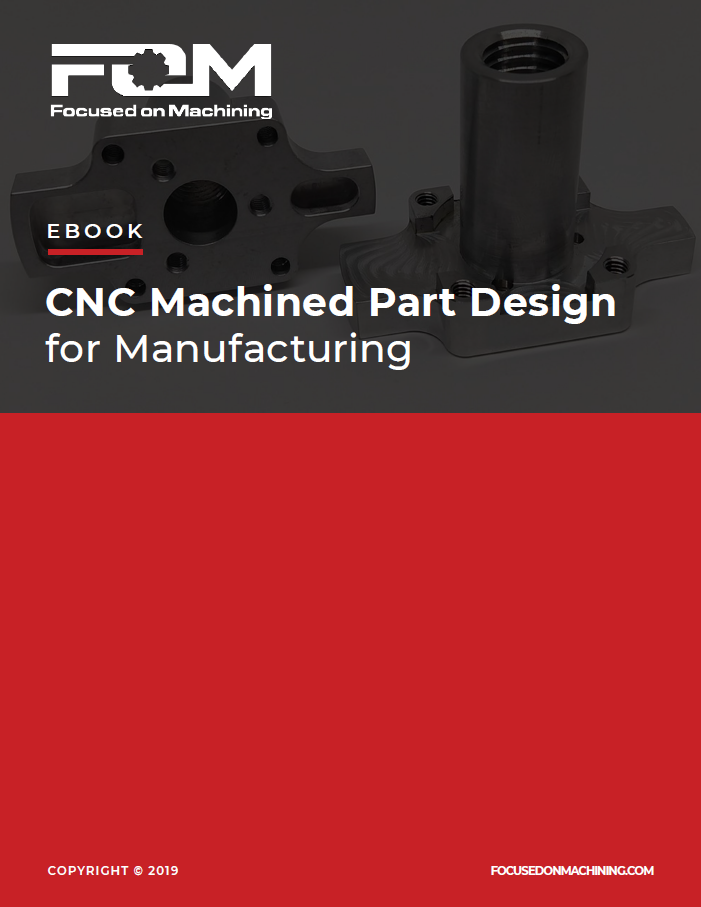
CNC machining design for manufacturing, why it’s important and how Focused on Machining can help.
One of the questions we get all the time when quoting CNC machining projects is “how did you land on this price?” or “why is this so expensive?”. The answers…
One of the questions we get all the time when quoting CNC machining projects is “how did you land on this price?” or “why is this so expensive?”. The answers can be complex, many factors go into pricing a part that varies based on the specific part geometry and customer requirements.

The two major factors of cost are tooling and time. Complex features often require special tooling to reach, cut, or form a part. These tools might not be needed again but must be expensed on a single job versus a tool that we could use every day and amortize the cost throughout the life of the tool. The other factor is time. As a machine shop, we sell time, time for the use of our expertise and machines. Some features will force us to slow down our cutting time vs. cutting fast like the machine is designed to do, this will increase the amount of time that the part is in a machine, keeping other jobs in the queue.
In an effort to reduce the time it takes for our customers to get parts on their desk, we created a CNC machining design for manufacturing eBook. The eBook is a guideline that communicates the cost drivers in machining and how to design parts to save on cost. Many of the topics in the eBook are not tolerance specific items, but general features that don’t change the intention of the part. This eBook can help you avoid putting features into the part that will increase costs unnecessarily.
In addition, there are a few items that we do not cover in the eBook that also increase costs, for example, material, plating, and shipping.
Material: Early in the design and prototype phase part quantities are typically low (we love prototype quantities at our shop!) One element that impacts cost is material usage. Most materials are sold in 12/20-foot bars, 4 x 8 feet sheets, or plates. Let’s use an example of prototyping a part out of 17-4 stainless, heat-treated to H900. Costs are going to be higher than a normal grade of 17-4, or even 1018 carbon steel. The reason for this is the amount of material used. A material supply house will absolutely sell a foot of material, but when they have to cut a bar, the remaining amount goes into their “remnants” section. Because this is not in their normal system, they will try to recoup a higher portion of that bar cost on the 1-foot piece that may be needed.
Plating/Heat Treating: All plating and heat treat shops have minimum lot fees. Most are in the $100-150 range. When prototyping, it’s important to consider this factor when there are only 1-5 parts. You’re simply increasing those parts by $25-$100 apiece for those services. When parts are proved out and higher quantities are achieved, the per piece prices for plating and heat treat can be $1 or less.
Shipping: Another factor that doesn’t get enough attention. A small quantity of parts in the prototype phase can have shipping costs attached to it 3-4X. For example, the initial material will be purchased online and shipped to the shop, shipping charge #1. Then it’s machined and shipped to plating, shipping charge #2. When plating is completed, it’s shipped back to the shop, shipping charge #3. Finally, the completed parts are shipped to the customer, shipping charge #4. All of these costs are charged to the machine shop and eventually built into the pricing for the customer.
Take a look at the eBook we’ve created - eBook Link. It will provide significant value during the design phase of your project. As always, we are available to talk anytime to help you get your project completed, feel free to reach out to us via our website, LinkedIn, or by phone.
Justin Quinn, President

How Focused on Machining Leverages Lights Out Manufacturing
Lights out manufacturing is the holy grail for machine shops, the thought of machining parts unattended can be daunting and is no easy task. For over a year…
Lights out manufacturing is the holy grail for machine shops, the thought of machining parts unattended can be daunting and is no easy task. For over a year, Focused on Machining has taken on this challenge, working towards processes and systems that allow us to run lights out so we can increase capacity and reduce costs. We finally achieved that feat in November 2019. It was a combination of hard work on programming, tooling, fixturing, and the right part count that all came together on a customer job.
Here is what we did differently to achieve lights out running from our normal day to day operation.
Programming: We typically program aggressively and achieve max feed and speeds on normal operations. However, to ensure a fail-safe operation without an operator we had to think differently about many things in our program. This is what we did:
Turned down the aggression in our program and reduced our speeds and feeds, not by a lot, but enough to ensure we weren’t going to rip the part out of the vise or risk breaking a tool.
Incorporated our spindle probe and tool probe into our program to check features and distances post machining to verify we’d achieved what we’d hoped.
Used the tool probe to check tool edges to ensure we hadn’t broken a tool during a cycle. These steps we’re performed after each part was machined.
Accounted for chips in the machine. We made tool path updates to ensure the chips would be blown a certain direction and not into a corner of the machine where they would build up and cause issues.
Tooling: We loaded redundant tooling into the machine in case we did lose a tool on an operation. (thankfully this wasn’t needed this time around) We upgraded a couple of tools for this job specifically and used higher quality endmills that would last longer and perform better during operations. This added a bit of cost to the job but was easily recouped by machining lights out.
Fixturing: This was the most challenging part of our task to achieve lights out. The goal was part density, we wanted as many parts in the machine as we could fit to take advantage of the number of hours after our normal shift as we could. We utilized an aluminum tombstone that saved weight and allowed for a greater part density on our pallet. We combined that with a modular rail system from tombstone city that allowed us to hold multiple parts per face of the tombstone.
Right Parts: This was the last piece, and we were happy to receive an order of 100 parts that had an ideal amount of cycle time in the machine. This allowed us to spend the time to develop all the other aspects that we previously covered.
Moving forward, Focused on Machining is making substantial investments into our lights out operation, building upon the current systems and modifying where necessary so we can depend less on “the right part” in order to make lights out a success. Our goal is to achieve lights out operations with as few parts as 3 or 4 parts. Stay tuned!
Justin Quinn, President