
A Case Study in 5-Axis Machining: Reducing Setups and Improving Lead Times
At Focused on Machining, our 5-axis machining is now running at full speed. As our team has gained experience with the new equipment, we have become more efficient in our manufacturing for 5-axis parts.
5-axis machining is often associated with complex geometries, and it does allow us to machine challenging contours and other difficult features more effectively than many traditional setups. But in our shop, customers have also seen major benefits in speed, as well.
One recent manifold project is a strong example of how 5-axis machining can improve efficiency and help keep demanding jobs on schedule.
A Complex Manifold With Tight Requirements
Focused on Machining has produced complex manifolds for years, and this recent project was an excellent example of the precision machining work we often do. The part was an aluminum block measuring roughly 2 inches by 2 inches by 12 inches, with 17 ports.
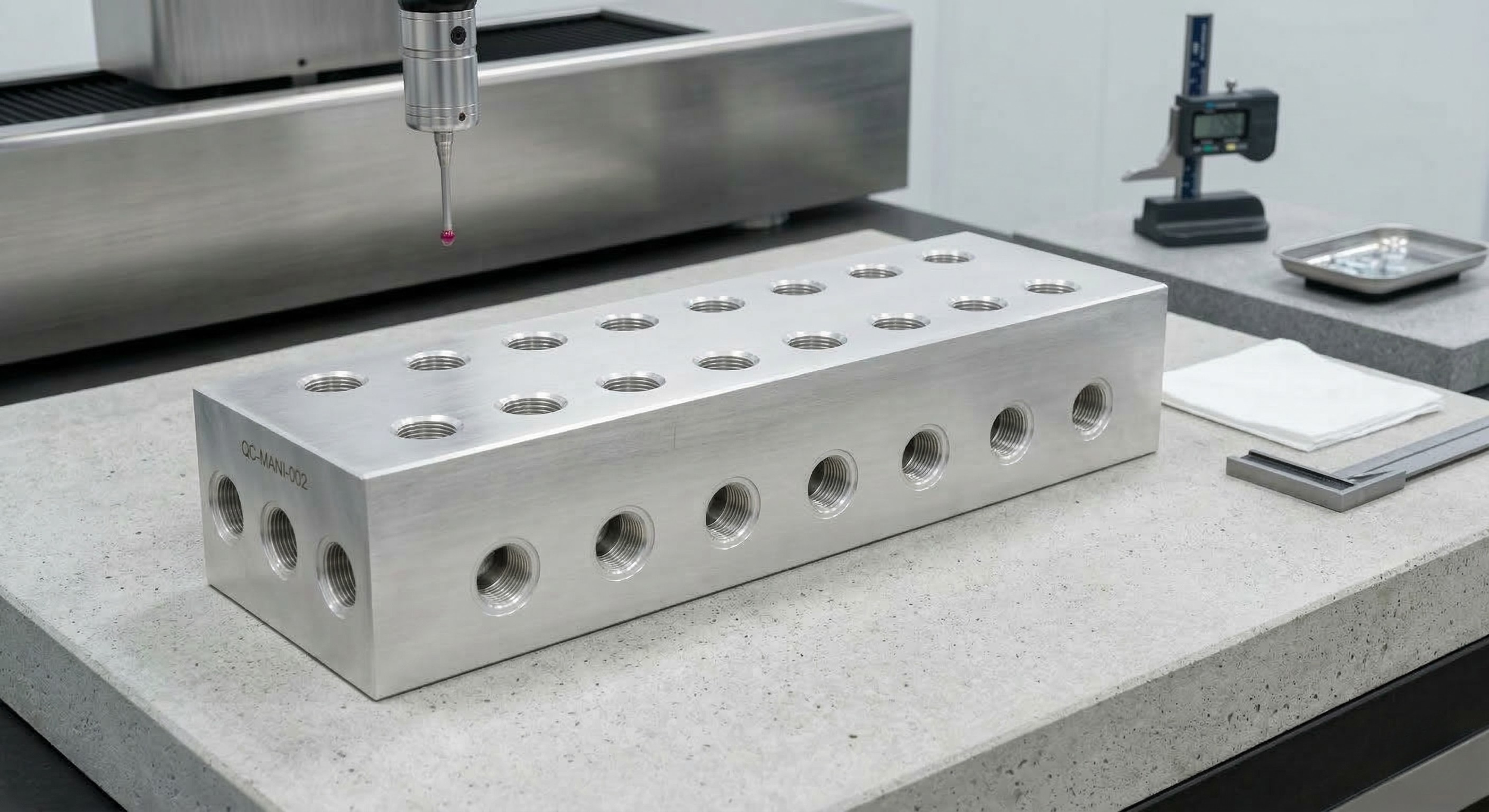
This manifold was part of our aerospace machining work for a customer. It was designed for fuel lines in a rocket engine, so positional accuracy was critical and the tolerance requirements on the holes were extremely tight. In fact, inspection did not stop at the physical surface of the part. We also had to project a feature location four inches out from the part and verify that it still met the required positional tolerance at that distance.
Before and After: Reduced Setups, Greater Efficiency
We originally quoted and planned this part before our 5-axis machine arrived, and at that point, we planned for the part on our existing equipment. Ultimately, though, we were able to machine it on our new 5-axis. That gives us a clear before-and-after comparison:
If we had machined this manifold on our horizontal machine, it would have required four operations.
On a vertical machine, it would have taken at least seven operations.
On our 5-axis machine, we completed it in just two operations.
How Reduced Operations Benefit Customers
For those who aren’t in a machine shop every day, it’s worth explaining what these terms mean. An “operation” is essentially a separate setup or machining step. Each time a part has to be repositioned or moved so a different side or feature can be machined, that adds another operation.
Fewer operations benefit customers in multiple ways. First, every time a part is handled in a setup, it introduces the opportunity for error. Second, each additional setup adds labor and production time because the part must be reoriented and verified before machining continues. Third, longer cycle times within fewer setups can create opportunities for unattended lights-out machining, which can significantly improve throughput.
Lights-Out Manufacturing Led to Scheduling Flexibility
This job also involved substantial outside processing that we coordinated on the customer’s behalf, including chem film and precision cleaning. Because of those requirements, we had very little room for delay during machining.
Fortunately, the reduced number of setups made a major difference. Cycle times were nearly three hours, and the 5-axis machine is palletized, which allowed us to load multiple parts at once. Those factors let us run these parts for approximately six hours unattended at night. As a result, we kept the project moving and met its deadline.
Always Getting Better, Faster, and More Cost-Efficient
Our experience with 5-axis machining is leading to consistent improvements in efficiency. We’re already seeing shorter production times, and we expect the trend to continue. And over time, we know increased efficiency will help reduce costs for customers in our contract manufacturing services.
If you have a part that could benefit from 5-axis machining, let’s discuss. Whether the priority is part complexity or shorter lead times, Focused on Machining is ready to help. Contact us today!